Luxa journal · manufacturing guide
Barrier Face Cream Development: Texture, Claims and Packaging
Plan a barrier face cream around texture, routine fit, ingredient systems, evidence-backed claims, packaging and sample approval.
In this guide
- 01Set the product role before the texture
- 02Translate richness into observable requirements
- 03Build an ingredient system, not a headline list
- 04Evaluate the cream in the intended routine
- 05Choose claims before choosing a test package
- 06Test the final cream in the final pack
- 07Keep release decisions separate
- 08Prepare a barrier cream development brief
A barrier-focused face cream needs a clearer brief than “rich moisturiser with ceramides”. The brand has to define who will use it, where it sits in the routine, how it should feel and what the finished product can support in its claims. Begin with the moisturising experience and intended use, then work through formula direction, layering, packaging and evidence as connected decisions. That keeps an appealing ingredient story from running ahead of the product that will actually be sampled, tested and sold.
Place the cream within a Korean-inspired skincare routine and define how its texture and finish work alongside the other products.
Every product is shaped by its formula, claims, packaging, target market and sales channel. Use this guide to prepare a sharper manufacturing conversation, then confirm technical, legal and regulatory requirements for your specific launch.
At a glance
Guide essentials
Start with
Routine role and desired afterfeel
Translate
Richness into observable targets
Separate
Ingredient properties from product claims
Test
The final cream in the final pack
01
Set the product role before the texture
A day cream worn under sunscreen and makeup has different priorities from a richer evening product. A minimalist routine may need a cream that works as the only moisturising step, while a more elaborate routine may call for a lighter finish over a serum.
Describe the intended customer without turning the brief into a diagnosis. Record the desired feel after application, the typical amount, relevant climate or use conditions and the other products likely to be used alongside it. If the concept involves a medically defined skin condition, pause and clarify the regulatory pathway with qualified advisers before treating it as an ordinary cosmetic launch.
Put the product role in the first paragraph of the brief. It gives the formulator a basis for balancing richness, spread, absorption feel and residual finish. If the cream is part of a wider range, the hero-SKU planning guide helps decide whether it leads or supports.
02
Translate richness into observable requirements
Texture language becomes useful when different reviewers can recognise the same target. Instead of “light but deeply nourishing”, specify the cushion on first contact, the spreading time, the level of shine and the finish after a defined interval.
These are sensory directions, not proof of efficacy. A thicker cream is not automatically more effective, and a gel-cream is not automatically less moisturising. Assess the formula and evidence on their own terms.
| Texture direction | Potential role | Main sample question |
|---|---|---|
| Gel-cream | A lighter-feeling daily layer | Does it meet the moisturising brief without unwanted tack? |
| Fluid lotion | Easy spreading and controlled dispensing | Is the body sufficient, and does the pack dose it well? |
| Cushion cream | A more substantial everyday moisturiser | Does the richness stay comfortable in the intended routine? |
| Rich cream | An evening or more enveloping feel | Does the residual film feel intentional rather than heavy? |
03
Build an ingredient system, not a headline list
Discuss humectants, emollients and film-forming or occlusive ingredients in relation to the product experience you want. If ceramides or other lipids are central to the concept, ask which ingredient forms, supporting system and processing approach suit the proposed formula.
Avoid prescribing a universal ceramide percentage or lipid ratio from an unrelated product. Raw materials differ in composition and supplied form, and the finished formula must stay compatible with its processing, preservation and packaging. The formulation team should explain what a proposed ingredient level means in this product, and the cosmetic formulation guide explains the wider route from idea to controlled prototype.
Published ingredient properties are useful development inputs, but they are not finished-product support. Under the EU common criteria for cosmetic claims, claims must rest on adequate and verifiable evidence, and the European Commission’s technical guidance adds that extrapolating an ingredient’s properties to the finished product needs its own support, such as showing the ingredient is present at an effective concentration.
04
Evaluate the cream in the intended routine
Test prototypes at the amount a customer is likely to use. Record spread, drag, whitening during application, tack, shine and the feel once the product settles. If the cream is meant to go under makeup or sunscreen, assess that sequence with identified products and consistent intervals.
Record pilling as an interaction under defined conditions rather than blaming one ingredient or product straight away. Repeat the observation before changing the formula, and check whether the dose, rubbing or the previous layer explains it.
Include repeated use in the evaluation plan where it matters to the brief. An immediate silky impression and longer-term acceptance answer different questions, and any user study must suit its participants and intended use, with appropriate safety oversight. The sampling guide sets out how to keep rounds comparable.
05
Choose claims before choosing a test package
Make a claims list early and separate the levels of promise. A sensory claim about comfort, a moisturising claim, a quantified duration claim and wording about repairing a damaged barrier carry different evidence and regulatory implications.
In the United States, FDA distinguishes products intended to cleanse, beautify or alter the appearance, a group that includes skin moisturisers, from products intended to treat disease or affect the structure or function of the body. Its cosmetic-versus-drug guidance is relevant when reviewing barrier, repair and treatment language. Adding “helps” does not make a claim acceptable.
For each proposed claim, record the exact wording, market, audience and evidence needed. Ask the testing partner what the method measures, which comparator or baseline is appropriate and what the result can legitimately support. A hydration measurement and a water-loss measurement answer different questions, and neither should be stretched into an unlimited repair promise. “Suitable for sensitive skin”, “hypoallergenic” and “dermatologically tested” also need precise substantiation; FDA notes there is no federal definition of “hypoallergenic”, and none of these terms guarantees that no user will react.
06
Test the final cream in the final pack
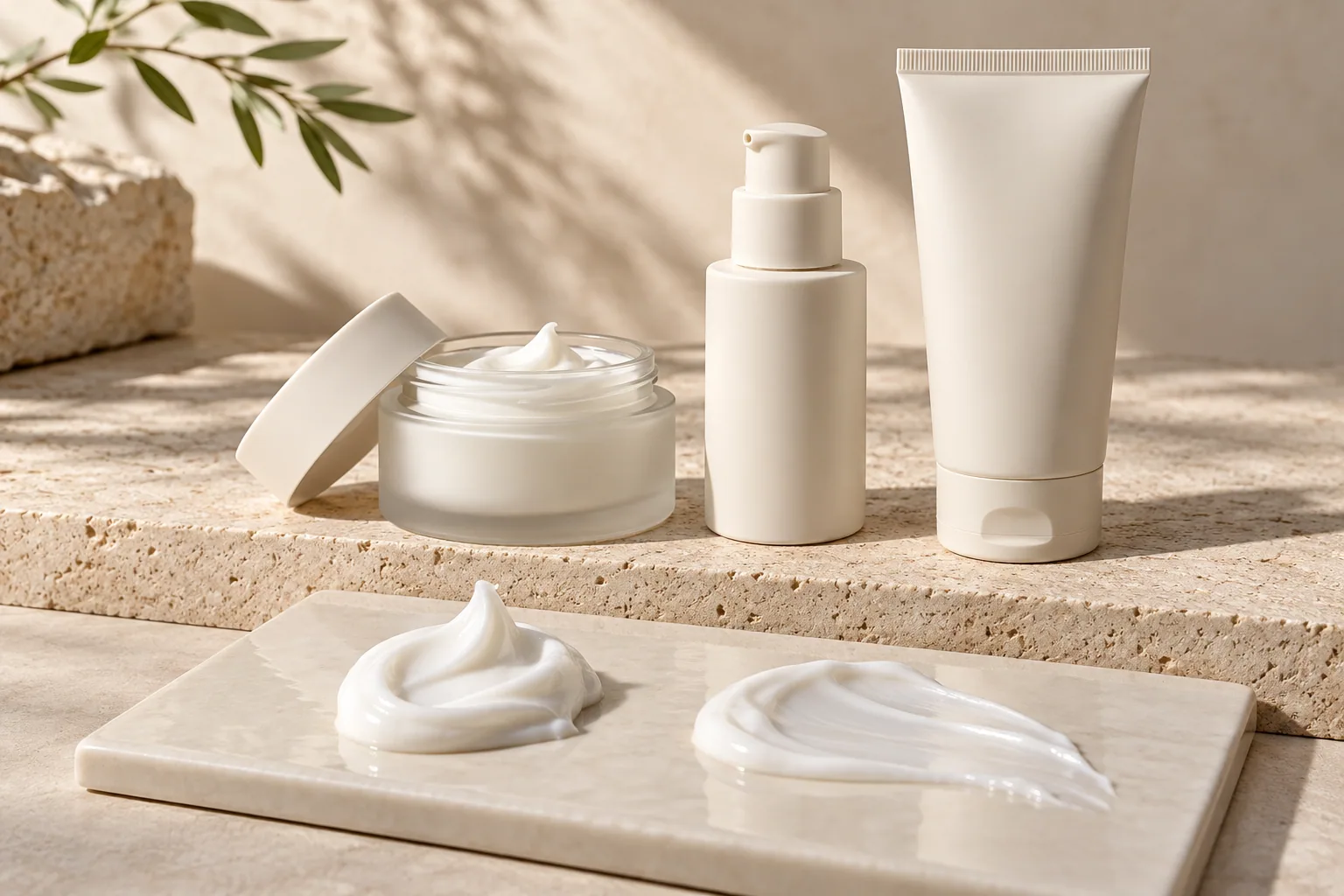
A jar, a tube and an airless-style pump give different experiences. Review access, dose control, closure cleanliness, travel behaviour and how much product the customer can realistically get out.
For a pump, test priming, dose consistency, blockage and evacuation with the actual cream. For a tube, assess squeeze force, nozzle behaviour, cap fit and residual product. For a jar, review access and foreseeable handling. An “airless” description does not in itself establish sterility, compatibility or a longer shelf life. The packaging page outlines the components Luxa can review with the formula.
Plan formula and packaging assessment together: appearance, odour, viscosity, separation, leakage and relevant material interactions, through a programme suited to the product. FDA’s product testing overview states that a manufacturer or distributor is legally responsible for ensuring a marketed cosmetic is safe; a supplier’s general certificate is not a substitute for finished-product assessment.
07
Keep release decisions separate
Use clear approval stages so the project does not move forward on an ambiguous “sample approved”. Confirm the sensory direction first, then the component with the formula. Resolve safety, stability and claim support with the responsible specialists, and finally release the agreed formula reference, pack, label inputs, artwork and production specification.
The exact sequence depends on the project and some work can run in parallel. What matters is knowing which evidence is complete and which decisions remain conditional, so that the brand, the manufacturer and other responsible parties understand their deliverables.
08
Prepare a barrier cream development brief
When you send a development brief, ask for a project-specific view of formula feasibility, sample stages, component compatibility and the evidence needed for your intended claims.
- Target countries, customer, sales channels and routine role.
- Day or night positioning, texture benchmarks and desired afterfeel.
- Ingredient priorities and restrictions, without treating them as proof of performance.
- Exact proposed claims and any existing supporting evidence.
- Layering requirements and the products used as benchmarks.
- Fill size, jar, tube or pump direction, decoration and outer packaging.
- Order quantity, testing needs, delivery destination and requested timing.
Continue your research
Make the next step useful
Bring the right details to your first product conversation.
Bring your routine role, texture benchmark, ingredient priorities and exact claims. Luxa can help align the formula direction, component and evidence plan.