Luxa journal · manufacturing guide
Milky Toner vs Essence: Plan Texture, Layering and Packaging
Compare milky toner and essence development through texture, routine role, layering, dispensing, claims and a practical manufacturing brief.
In this guide
- 01Treat the name as positioning, not a specification
- 02Write a sensory brief that can be evaluated
- 03Plan the formula around the whole experience
- 04Test layering in the routine you intend to sell
- 05Match the closure to the real flow
- 06Establish safety and claims evidence before artwork
- 07Prepare a milky toner or essence brief
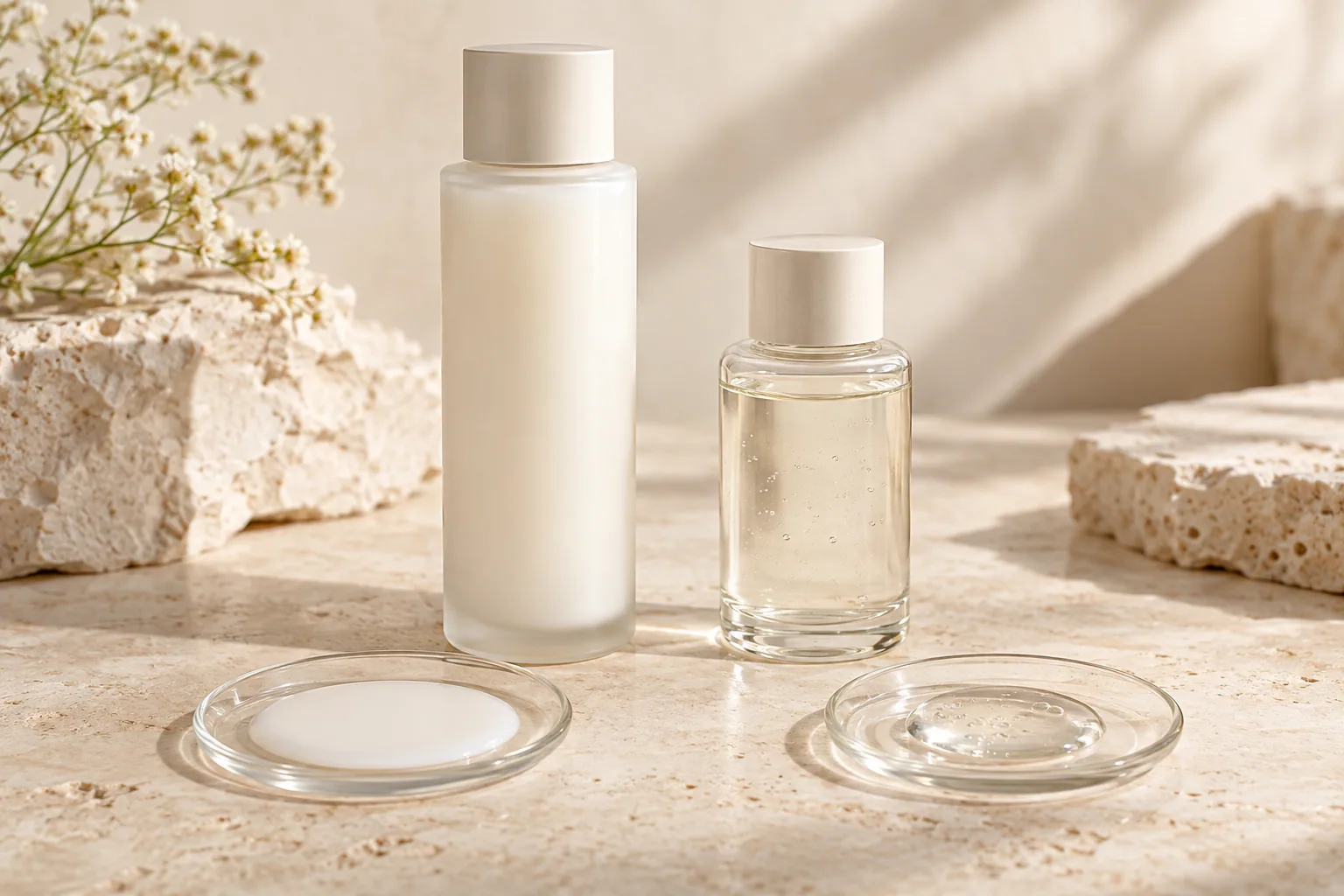
A milky toner and an essence can occupy the same step in a routine and still lead to very different development briefs. The name does not tell a manufacturer how rich the product should feel, how it should dispense or what it must do under the rest of the routine. Start with the application experience, whether a light post-cleanse layer, a cushiony hydrating step or something closer to a treatment, then choose the name, formula direction and pack that express it accurately.
Bring fluid textures into a Korean-inspired skincare collection developed and manufactured in China for your brand.
Every product is shaped by its formula, claims, packaging, target market and sales channel. Use this guide to prepare a sharper manufacturing conversation, then confirm technical, legal and regulatory requirements for your specific launch.
At a glance
Guide essentials
Start with
The experience, not the category name
Brief
Dispensing, spread, finish and dose
Test
Layering in the routine you will sell
Match
Closure to the real flow of the formula
01
Treat the name as positioning, not a specification
In commercial use, “toner” usually signals a fluid applied after cleansing. “Essence” usually signals a leave-on layering step with a more treatment-led story. “Milky” describes an appearance and a sensory expectation. The terms overlap, so a manufacturer-ready brief has to go further.
A product may look milky because of its formula structure, but appearance does not tell you how much moisturising benefit it delivers. A clear essence is not automatically lighter or less hydrating than an opaque toner either. Judge the whole formula and the finished-product evidence rather than a hierarchy built around the name.
The practical question is what this product adds to the customer’s routine. If the answer is indistinguishable from an existing serum or moisturiser, reconsider its role before adding another SKU.
02
Write a sensory brief that can be evaluated
Describe the journey from bottle to skin. Does the customer pour it into a palm, shake drops onto a cotton pad or dispense it from a pump? Should it spread immediately, give a brief cushion or leave a visible dewy finish? How soon should the skin feel ready for the next product?
These are development directions, not fixed definitions. A milky toner can be very fluid and an essence can have real body. Supply reference products and identify the exact qualities worth keeping.
Rank the requirements when they pull against each other. A very rich afterfeel, a watery pour and an almost undetectable finish may not all be achievable at once, so tell the development team which should win when prototypes differ.
| Decision | Lighter fluid direction | More cushiony direction |
|---|---|---|
| Dispensing | Controlled drops or a low-viscosity pump | A pump or opening matched to a thicker flow |
| Application | Fast spreading and a thin layer | More body and a slower pressing or massage step |
| Finish | Low residue or a subtle sheen | A more noticeable conditioned feel |
| Main sample question | Does the light texture still meet the benefit brief? | Does the richer feel layer without excessive residue? |
03
Plan the formula around the whole experience
Humectants, emollients, emulsifiers and texture modifiers each shape the finished product. Choosing a fashionable ingredient list before defining the texture can make the brief harder to resolve. Begin with the application and finish you need, then discuss formula architecture and ingredient options with the formulator. The cosmetic formulation guide explains that wider process.
For a milky direction, ask how the appearance and dispersion will be maintained over the intended shelf life. For a clear essence, ask what clarity means in the actual pack and whether any haze, sediment or colour change is acceptable. Set standards against the approved sample rather than a word such as “premium”.
An intentionally bi-phase toner is a separate design choice. Its layers, mixing behaviour, dose after shaking and return to the resting appearance all need specifications. Distinguish planned separation from an emulsion that separates unexpectedly. For every format, review fragrance direction, ingredient restrictions and the proposed pH specification for this formula and market; do not copy a pH or concentration from a different product.
04
Test layering in the routine you intend to sell
Layering problems are easy to miss when samples are only tried on a clean forearm. Before facial evaluation, have the qualified development or safety team confirm the sample is suitable for that use test. Then apply the intended dose to the face in the sequence you plan to recommend, including the serum, moisturiser, sunscreen or makeup that typically follows.
Record the amount applied, the time between layers and the products used. Look for pilling, excess shine, tack, uneven foundation or a finish that changes unexpectedly. If customers are likely to apply more than one layer, test that behaviour too. A structured sampling process keeps these observations comparable across rounds.
Keep sensory observations separate from claims. “Panel members preferred the feel under makeup” and “improves makeup wear” need different evidence: the first can guide development, the second needs a study designed around the promised outcome. Change only a few variables between versions so that feedback stays interpretable.
05
Match the closure to the real flow
An opening that works for water may release too much of a fluid emulsion, and a pump chosen for a thicker lotion may dose a lighter product inconsistently. Test dispensing with the actual formula in the intended component, including when the bottle is nearly empty.
For a pourable format, check dose control, drips around the neck, cap cleanliness and leakage after transport simulation suited to the distribution route. For a pump, review priming, dose consistency, clogging, closure security and how much product can be evacuated. If shaking is genuinely needed, establish that in development and write clear directions; “shake well” should never hide unresolved instability.
The pack also shapes expectations. A dropper suggests precision but is inconvenient for a generous dose, while a wide opening feels easy but encourages over-application. Choose the component after reviewing the whole use sequence, not only its shelf appearance. The packaging page outlines the bottle and closure options Luxa can review.
06
Establish safety and claims evidence before artwork
Water-containing leave-on products need a product-specific microbiological safety strategy. Ask the qualified development and safety team about preservative efficacy, microbiological specifications and pack-related risks. FDA’s overview of microbiological safety and cosmetics lists contaminated raw materials, ineffective preservation, unprotective packaging, poor storage and consumer use among the ways microorganisms get into products.
“Hydrating”, “soothing” and duration claims each need a defined meaning and appropriate support. The presence of a well-known ingredient is not proof of the finished product’s performance. The EU common criteria for cosmetic claims require claims to be supported by adequate and verifiable evidence.
Keep disease-treatment and other therapeutic promises out of an ordinary cosmetic brief unless the product is deliberately being developed through the applicable regulatory pathway. Review the final wording for each market, including product pages and advertising as well as the label.
07
Prepare a milky toner or essence brief
Before selecting a sample, agree what success looks and feels like: appearance, odour, flow, application, finish, layering, pack function and relevant stability observations, with the formula and packaging references recorded together. Ask the manufacturer what remains provisional. A preferred bench sample may still need compatibility work, scale-up review or claim testing, and keeping those items visible stops a sensory approval being mistaken for a production release.
When you share the brief with Luxa, ask which existing or development route fits the intended experience, with formula, packaging and evidence requirements considered together.
- Intended product name and its role in the routine.
- Customer, destination markets and sales channels.
- Texture benchmarks, appearance, application method and afterfeel.
- Ingredient priorities, restrictions and fragrance direction.
- Typical dose, layering sequence and performance priorities.
- Bottle size, dispensing format, decoration and carton.
- Proposed claims, testing needs, order quantities and launch timing.
Continue your research
Make the next step useful
Bring the right details to your first product conversation.
Bring your texture benchmark, dispensing preference, layering routine and intended claims. Luxa can help match the formula direction and bottle before sampling.