Luxa journal · manufacturing guide
Hydrogel Mask Development: Fit, Serum, Pouch and Claims
Develop a hydrogel mask brief covering fit, gel and serum compatibility, pouch protection, handling, claims and sample evaluation.
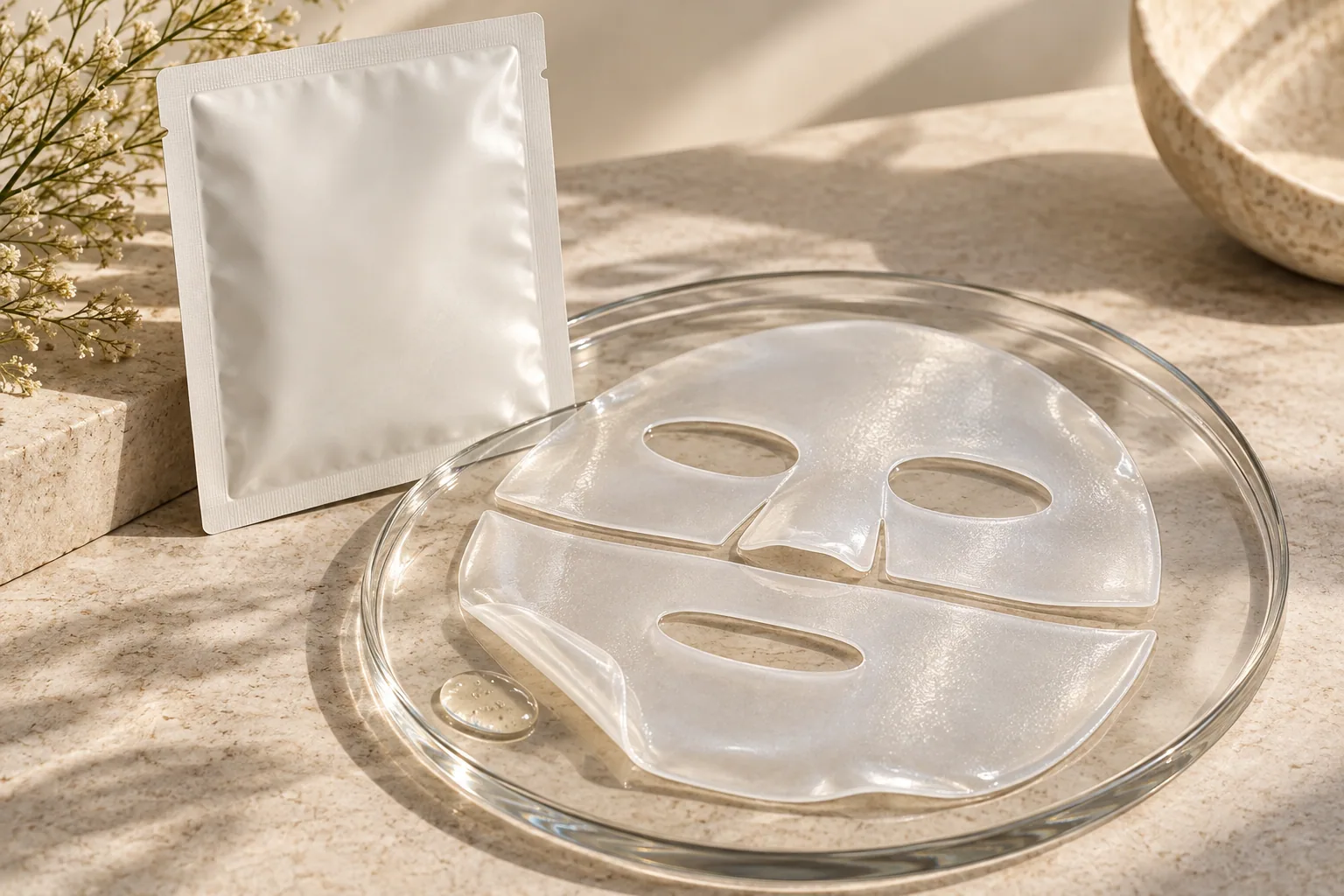
In this guide
- 01Define the treatment area and wear occasion
- 02Develop the shape for real faces
- 03Balance handling strength with comfort
- 04Review the gel and formula as one system
- 05Design the pouch around protection and opening
- 06Plan microbiological and stability work early
- 07Make every claim traceable to evidence
- 08Score hydrogel samples consistently
- 09Prepare a hydrogel mask enquiry
A hydrogel mask is experienced as a complete system. The customer opens a pouch, separates and positions the pieces, wears them for a stated time and removes them. A promising serum story will not rescue a mask that tears, slides or is hard to unfold. For a private label hydrogel mask, the brief should connect gel, geometry, formula, protective layers and pack from the start. This guide covers the decisions that make samples useful and the claims that need evidence before launch.
Explore the mask as part of a Korean-inspired skincare collection with a shared routine and packaging identity.
Every product is shaped by its formula, claims, packaging, target market and sales channel. Use this guide to prepare a sharper manufacturing conversation, then confirm technical, legal and regulatory requirements for your specific launch.
At a glance
Guide essentials
Define
Treatment area and wear occasion
Evaluate
Gel, serum and pouch as one system
Fit
Test on more than one face shape
Remember
A sealed pouch is not proof of sterility
01
Define the treatment area and wear occasion
Start with where and how the mask will be used. A full-face mask for a quiet evening, a two-piece mask that allows some movement and a targeted under-eye patch each create different fit and handling requirements.
State the intended wear time as a development target, not a validated instruction. The final directions must follow the finished product’s safety and use evidence. A competitor’s overnight claim or a social-media routine is no basis for recommending overnight wear of a new mask.
Decide too whether the product is a single-use pouch or a multi-use jar of individual patches. They are different packaging and handling systems and should not share one unchanged risk assessment simply because both contain hydrogel.
02
Develop the shape for real faces
A visually balanced die-line can still fit poorly. Review the position and size of the eye and mouth openings, the nose area, coverage at the cheeks and jaw, and any overlap between pieces. The aim is useful contact and comfortable placement without forcing every face into one assumed geometry.
Luxa’s hydrogel mask route reviews full-face, two-piece and targeted formats against available tooling. Ask which shapes already exist, what can be adjusted and which changes need development work. A custom outline can affect material use, handling and the supporting pack, so settle the essential geometry before decorative details.
Have the qualified development or safety team confirm a sample is suitable for on-face evaluation, then assess more than one face shape and size within an appropriate group. Record where the mask lifts, folds, overlaps or blocks the intended area. For targeted patches, check the area actually covered rather than the silhouette in a product photograph.
03
Balance handling strength with comfort
The mask has to survive removal from the pack and placement without becoming unpleasantly stiff. Ask for sample comparisons that make differences in thickness, flexibility, surface feel and handling visible. Thicker is not automatically more premium, and thinner is not automatically better contact.
Review the whole opening sequence. Can the customer find the right edge? Are the protective layers distinguishable from the mask? Do the pieces separate without tearing? Are the instructions clear without a demonstration video?
Assess slippage under the intended conditions. A mask designed for reclining does not need to promise secure wear while doing housework, but if movement is part of the proposition, test it rather than relying on a photograph of an upright model.
04
Review the gel and formula as one system
Evaluate the hydrogel material and any accompanying liquid together. Ask the development team to assess compatibility, changes in texture or dimensions, liquid distribution, separation and the condition of the mask over time. A formula that works in a bottle is not automatically suitable inside a gel-and-pouch system.
Specify the experience when the pack opens. Too much free liquid makes handling messy; too little undermines the application feel. Set the target through controlled sample evaluation rather than treating a larger declared serum amount as a measure of effectiveness.
Keep the ingredient story restrained. A mask turning clearer during wear is an appearance change, not proof that collagen or any other named ingredient has entered the skin. Published research on one hydrogel composition may help a formulator understand options, but it does not validate a different formula, construction or product. Keep supplier information, published studies and finished-product results clearly separated.
05
Design the pouch around protection and opening
A pouch must protect the product through the supply chain and still open in a controlled way. Review its dimensions, material construction, seal, tear feature and relationship to the mask and protective layers, and ask how the construction will be assessed for loss, leakage and compatibility.
Check the opening experience with filled, sealed samples. A tear notch that works on an empty pouch may be less useful when the contents sit right behind it. Opening should not easily damage the mask, spill the contents or leave confusing layers inside.
Leave space on the pouch for legible directions, required market information, batch identification and the full ingredient list. Avoid simulated technical seals or unsupported clinical language. For multi-use patch jars, assess the closure, retrieval method, remaining contents after repeated opening and foreseeable handling separately; evidence from a sealed single-use pouch does not transfer to a jar opened every day. The packaging page outlines the sachet, jar and carton routes Luxa can review.
06
Plan microbiological and stability work early
A sealed pack is not proof of sterility or adequate preservation. FDA’s overview of microbiological safety and cosmetics links contamination risk to raw materials, manufacturing conditions, preservation, packaging, storage and consumer use.
Ask qualified specialists to define the safety, microbiological and stability programme for the combined formula, mask material and pack. Share the intended markets, storage conditions and directions, and do not borrow a generic shelf-life figure from a different mask.
Record changes that matter to the customer as well as laboratory specifications: pieces that become hard to separate, more tearing, loss of fit, altered feel, colour or odour change and leakage. The stability guide provides the wider framework; keep the mask-specific details explicit in the project plan.
07
Make every claim traceable to evidence
Agree the exact claims before commissioning studies or finalising the pouch. “Leaves skin feeling hydrated”, a quantified hydration claim and a promise about collagen production are very different statements, and the study design and regulatory review must match the claim.
The EU common criteria for cosmetic claims require adequate and verifiable support. In the United States, a product intended to affect the structure or function of the body can be regulated as a drug, as FDA’s cosmetic-versus-drug guidance explains.
Claims about rebuilding collagen or delivering ingredients deep into the skin need both appropriate evidence and a review of the product’s regulatory status. Do not promise suitability for every sensitive-skin user or guarantee that no reaction can occur, and apply the same discipline to demonstration videos, retailer descriptions and creator briefs.
08
Score hydrogel samples consistently
Compare prototypes through the same documented sequence, and keep the formula, gel material, geometry, fill and pouch references with every sample. A change to any of them may need a fresh assessment rather than a visual approval. The sampling guide explains how to control versions across rounds.
- Opening: a controlled tear, limited spillage and clear access to the contents.
- Handling: easy separation, identifiable protective layers and resistance to tearing.
- Fit: opening positions, useful coverage, edge lift and comfort.
- Wear: slippage, feel and condition at the proposed removal time.
- Removal: ease of taking off the pieces and the intended residual feel.
- Pack and stability: seal integrity and relevant changes in the finished system.
09
Prepare a hydrogel mask enquiry
Send the target markets, customer, application area, format, benchmark, wear occasion, geometry requirements and packaging direction. Add ingredient priorities, exact claim intentions, order quantities, delivery destination and launch timing, and say whether the concept depends on custom tooling or a particular protective-layer arrangement.
When you discuss the complete mask brief, ask which material, shape and packaging options are established, which need development and what evidence is still needed before release.
Continue your research
Make the next step useful
Bring the right details to your first product conversation.
Bring your mask format, wear occasion, geometry needs and pack direction. Luxa can help identify established options and the development work a new concept would need.