Luxa journal · manufacturing guide
Private Label Lip Liner: Plan Pencil Format, Shades and Wear
Develop a private label lip liner with a clear brief for pencil format, shades, glide, wear, packaging and sample approval.
In this guide
A good lip liner draws the line your customer wants, copes with the way they use it and still works at the end of the pencil. A fashionable shade or a long-wear benchmark is only the start. The most useful sequence is to define the liner’s role, choose the pencil format, approve a focused shade range and then evaluate formula and component together. This guide covers the decisions to settle before you request private label lip liner samples or compare quotations.
Every product is shaped by its formula, claims, packaging, target market and sales channel. Use this guide to prepare a sharper manufacturing conversation, then confirm technical, legal and regulatory requirements for your specific launch.
At a glance
Guide essentials
Decide first
Outline, contour or all-over colour base
Separate
Pencil mechanism from tip size
Approve shades
On lips, against physical standards
Check colourants
Lip-use permission in each market
01
Define what the liner is meant to do
A precise outline, a softly blended contour and an all-over colour base ask different things of the same pencil. Decide which is the main use and which are secondary. A very soft, broad line may suit filling the lips but frustrate someone who wants a crisp cupid’s bow. A firm, fine tip gives control but may need more passes to cover a larger area.
Write the brief in terms other people can observe. Replace “creamy and long-lasting” with the glide, line width, first-pass colour, blending time and set finish you want. Include a physical benchmark, and say which of its qualities you want to match rather than asking for an unspecified copy.
Also state how the liner will be sold. A standalone pencil needs a clear shade identity. A lipstick companion needs a deliberate relationship to the lipstick collection, and the matte vs satin lipstick guide covers how the two are tested together. A contour-led launch needs enough depth and undertone variation to work across the customers it serves.
02
Choose the pencil format before the formula
Treat the pencil mechanism and the tip size as separate decisions. Sharpenable and retractable describe how the component works; slim and broad describe how the line is applied. Review both against the intended use.
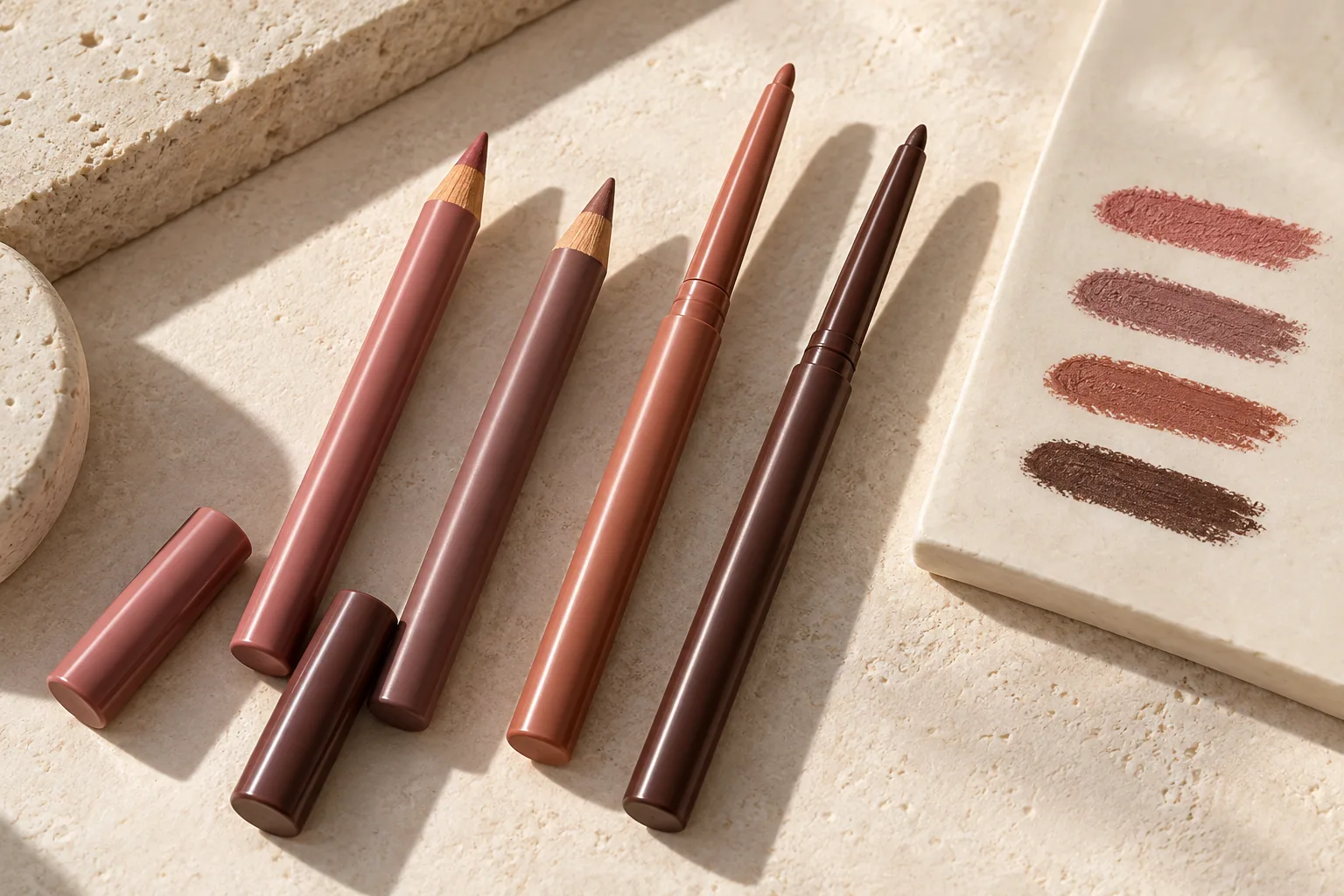
Luxa’s private label lip liner route covers sharpenable wood, moulded and twist-up mechanical pencils. Specify the diameter and mechanism you want, whether a sharpener is included, the usable fill and the closure. Ask which choices use established components and which would need new tooling or component development.
Treat cap fit as a performance detail, not a styling one. If the formula depends on limited exposure to air, check it in the actual pack rather than assuming every cap protects it equally well.
| Design choice | Development focus | What to check in the sample |
|---|---|---|
| Sharpenable pencil | Tip shape, core support and sharpening behaviour | A clean point, core breakage, shavings, cap fit and a compatible sharpener |
| Retractable pencil | Convenience, exposed-core strength and mechanism performance | Advance and retraction, wobble, cap retention and use near the end of the fill |
| Slim precision tip | Line control and detailed application | Whether the tip holds under normal pressure without dragging |
| Broader contour tip | Soft outlining and filling larger areas | Edge definition, even coverage and how easily the line blends |
03
Build a shade architecture, not a list of names
“Rose nude” and “warm brown” are not reproducible colour standards. Build a shade sheet that records depth, undertone, opacity, finish and any lipstick or gloss pairing. Anchor each name to an approved physical standard.
Before anyone applies a sample to their lips, have the qualified development or safety team confirm it is suitable for that use test. Then review colour on lips, not only on white paper. Natural lip colour, the thickness of the deposit and the edge of the line all change how a shade looks. Include a range of natural lip tones and record the result when the pencil is used for outlining and for filling.
Each shade in a first range needs a reason to exist. Two pencils that look distinct at the tip may be almost interchangeable as a thin line, while a small undertone difference can matter beside a lipstick. Ask about minimums by shade, any total-order requirement and the cost of adding a colour later. One overall minimum cannot always be divided freely across every shade and pack variant; the MOQ planning guide explains why.
04
Balance glide with control and wear
Review the first stroke separately from the set film. A sample can feel impressive on application and still be hard to blend, migrate at the lip edge or feel uncomfortable after repeated use. Use the same scorecard for every sample.
Define the wear conditions before assigning a performance claim. Water, rubbing and eating are different challenges, and a result under one condition does not support an unrestricted “waterproof”, “transfer-proof” or all-day promise. For a quantified wear claim, agree the method, duration, participants and acceptance criteria with an appropriate testing partner.
Keep the shade code, sample reference and test conditions with every score. “Sample B is better” loses its value quickly if nobody can later identify the sample or how it was applied.
- Application: pressure needed, dragging, skipping and colour in one pass.
- Line quality: edge definition, achievable width and control around the contour.
- Blending: working time and whether blending leaves an uneven edge.
- Wear: fading pattern, feathering, transfer and appearance after a defined routine.
- Comfort and removal: dryness, build-up and removal with a suitable cleanser.
- Component: breakage, sharpening or mechanism behaviour, cap fit and decoration durability.
05
Review colourants and claims for each market
A lip liner’s colourants need checking for lip use in every destination market. In the United States, FDA’s colour additives fact sheet explains that permission for externally applied cosmetics does not extend to the lips, and that some colour additives also need batch certification. The permitted colour additives table links each colourant to its specific restrictions.
A lip pencil should not be promoted for the eye area just because it is a pencil. Any extra use area needs its own formulation, colourant and safety review. Keep the intended use consistent across packaging, product pages and creator instructions.
Other claims need a defined basis too. “Vegan”, “fragrance-free” and “dermatologically tested” mean different things and need different records. Ask what the finished formula, raw-material documents and actual study reports support; an ingredient supplier’s brochure does not establish a claim for the finished pencil. The quality and compliance overview explains how Luxa approaches that review.
06
Approve production details as one specification
Before production, bring the approved shade, formula reference, pencil component, cap, decoration, fill and carton artwork into one release record. Include the physical colour standard and agree how colour differences will be judged under defined lighting.
Ask how the project will check the failure modes that matter for pencils: broken cores, uneven colour deposit, mechanism faults, loose caps and damaged decoration. Agree what is checked on incoming components, during production and on finished packs, so acceptance is clear before a discrepancy appears.
Share the real distribution conditions. A pencil sold through warm-climate ecommerce needs an evaluation plan that reflects that route; a single studio sample cannot show how the packed product behaves through transport and customer use.
07
Prepare a lip liner enquiry
Ask for a quotation that separates formula and sample work, components, decoration, testing, any tooling and finished-product production. Confirm minimums and timing for your actual configuration rather than borrowing figures from another pencil project.
Use the packaging page to frame barrel, cap and carton choices. If the pencil will support a wider lip collection, the lip gloss vs lip oil guide helps define its companion product. Then discuss your lip liner brief with Luxa with the shade and component decisions clearly identified.
- Target countries, sales channels and intended customer.
- Main use, reference products and the attributes to match or change.
- Pencil format, component references, usable fill and packaging direction.
- Shade count, physical colour standards and quantity by shade.
- Glide, line definition, blending time, finish and wear priorities.
- Intended claims and any evidence or testing already available.
- Decoration, carton, delivery destination and launch timing.
Continue your research
Make the next step useful
Bring the right details to your first product conversation.
Bring your pencil format, shade standards, quantity by shade and wear priorities. Luxa can help you check which components and formula routes fit before sampling begins.